
Alright mates! We will keep it light this weekend. Till the following posts start rolling -and there are some good topics on the chain- this is a Christmas gift for you: The most entertaining clasico Between Barcelona and Real Madrid. Each Video rewind 15 minutes of the show, Enjoy the match!


I had no chance to share my thoughts regarding the clasico, blame my time consuming work. Lot to say about Barcelona's domination and Real Madrid's collapse.Though I stumbled on this demonstration of magical football or boring football, depending on what kind of soul you have.
I already stated my opinion about this argument in less than 100 words (I guess). If you are lazy to click the link - and i know you are- I repeat it here:
"The word on the street complains about how boring the Spanish Tike-taka football is. And I have to agree with that. I remember when I was a child playing football with my older uncle in the backyard.
He used to dribble the ball around me in circles showing up his dominance. I used to chase the ball desperately trying to win it back.
It took me ages to succeed. Then in one moment or two he used to win it back again. That was so.damn.Boring."
FC Barcelona: Valdés; Alves, Piqué, Puyol, Abidal; Xavi, Busquets, Iniesta; Pedro, Messi, Villa
Real Madrid: Casillas; Ramos, Pepe, Carvalho, Marcelo; Xabi Alonso, Khedira, Di Maria, Ozil; C.Ronaldo & Benzema.
You can check the match preview here.
Mourinho picks the predicted lineup expect Benzema for Higuain who picked an injury. Pep -also as predicted- goes for the traditional lineup seeking to outscore the opponent. Lets see what kind of interesting role Pedro will play. Keep your eyes on him to read Pep's mind.
Dont miss watching the vedio on this post. It may save your life tonight!

Dedummm… Dedummm… Dedummm…a dim beat coming from a distance. You barely hear it but it still fills you with discomfort and you visualize all kinds of ghosts, freaks and serial killers hiding in the bush of your own anxiety and moving as died shadows in a dark forest. The beat is only getting louder and louder turning apart the last shelter of patience and certainty you shield behind. Clasico time!
I am not enjoying the luxury of time lately to read all what the internet delivers about football on daily bases. A fast ramble across the web gave me an impression that a massive number of posts were written covering the clasico, and that’s not a surprise. There is more focus on the tactical aspect of the game this year than usual. First, because the two clubs –for the first time in recent year- are equipped with massive quality in each and every position. When two teams become that close concerning individuals, tactics turn to be the deciding factor. And secondly, because there is a Mourinho in the hood this time, and while the majority only remember Mou beating Barcelona in the champion’s league semi final last season and consider it a tactical victory for Mou over Pep, they forget that Pep outclassed Mou tactically in the group stages of the same year, beating him without even using the key players of offense. This is another reason that makes this match more interesting to follow.
Maybe, the main flaw I noticed in my fast scan on the net, is that people are predicting the team’s approach based on what we saw against Almeria (Barcelona) or Athletic Bilbao (Real Madrid). It is unlikely that the two teams make revolutionary changes –especially Pep- but the selections (or at least the tactics) will be tuned to meet the special demands of the big game. There is a special interest to see how both coaches will prepare their troops for this battle.
It is not the first time we predict that Pep will accept some compromises regarding the team approach, and he almost proved us wrong each and every time. Sometimes he was right to ignore my demands, other times he wasn’t.
Barcelona’s usual selections and Real Madrid rumored defense

It will be interesting to see if Mourinho’s priority will be checking Alves or preventing Iniesta from opening to the left flank. Di Maria’s position will define that. One option is having Di Maria on the left as represented in the photo and using Ronaldo to help defensively on Alves flank. Another option is to use Di Maria on Barca’s right to check Alves and releasing Ronaldo to a more offense oriented role.
How will Real Madrid defense work?
The above photo represents another rough presentation that is not realistic almost at any specific moment of the game. Mou will mix tactics he used at Inter against Barcelona with Rubin Kazan’s tactical lesson in defense that inspired lot of Barcelona’s opponents afterward.
If you take another look at the photo above, it is easy to notice lot of flaws in defense. Mou will make sure his team doesn’t fall in this trap often during the game. On Barca’s right, Messi-Xavi-Alves-Villa will keep being capable to break into the box through one touch and interchanging, especially that Ronaldo –no matter how disciplined he will be defensively- it is unlikely that he will keep tracking Alves that far into Real Madrid third. Ronaldo’s transition release Barca’s defense to contribute more often in the buildup and possession game. Asking Ozil to help the two holding midfielders will uncheck Busquets and lead to the same. Any of the mentioned leads Barcelona to spend more time in Real Madrid’s third than Mou can tolerate. That’s why there is a possibility that Mou sacrifice either Ozil or Higuain for Lass. Yet, there is a better option.

Rubin Kazan coach succeeded to create a system to defend Barcelona both horizontally and vertically. The common presentations we find through the internet arrange players in a very casual manner with every player being in his nominal position. When Barcelona attacks Real Madrid left flank, we will see Ramos playing as a right center back with Pepe, freeing Carvalho to create a diagonal depth between Marcelo and Alonso who moves to help closing the flank, Khedera more central and Di Maria as a pending holding midfielder (Similar to Pendev role when Inter met Barcelona in the Champion’s league). The whole positioning structure shuffles symmetrically when Barcelona attacks from the opposite flank. When Barcelona move the ball to the center, Real Madrid fullbacks will both move closer to the box to close any spaces in the center where Barcelona are more lethal than the flanks, especially with Pepe and Carvalho being dominant in the air in case Barcelona flanks crossed the ball to the box.
For this structure to work, Xavi and Busquets are the main key players Mourinho will check. Barcelona can break down this defense by moving the ball continuously from one flank to another forcing Real Madrid players to continuously re-consider their positioning and roles on the field. That’s extremely exhausting both physically and mentally. Rubin Kazan showed a successful demonstration. Attract Barca offense to one flank and compress it there by creating a vertical line that prevent Barcelona players from releasing the ball to the center or to the Area (unless if through crossing, which is not the most dangerous options for Barca offense). This means that instead of defending Barcelona across the whole width of the field, drag them to one flank and concentrate the defense to contain them there.
Though, it worth repeating that Mou will try to avoid the situation where Barcelona settle in Madrids third by putting pressure in Barca’s half to disturb the buildup. Checking Pique and Busquets will force Xavi and Iniesta to come closer to their defense to help releasing the ball forward. That situation serves Real Madrid holding midfielders who will not be under continuous pressure leading to mistakes. It will offer the defense a refreshing break. It will help Di Maria to contribute more in offense as well.
Real Madrid offense
Real Madrid offense cause most danger when they win the ball in the opponent’s half. That’s why they will try to do exactly that. But it is also a given that Real Madrid is one of the best teams in the world in generating counter attacks. In Barcelona, Mou will find a great feast, a team with high defense line and offense dedication. Based on Barcelona’s initial game plan, we can visualize Real Madrid counters blowing as follows:

There are lot of talks about Ronaldo Vs Alves on the flank. There are lots of expectations that Ronaldo will expose Alves “defensive flaws”. In my opinion, this is an irrelevant argument, simply because it is not Alves job to check Ronaldo. Assuming that Alves is a traditional fullback is not true. If Alves think of Ronaldo while contributing in offense, he will run forward while looking back. That will reduce his offense contribution without really enhancing is defense output. Secondly, if Alves check Ronaldo, who will take care of Marcelo?
Here comes the first change in Barca’s selection above. The solution of Ronaldo/Marcelo combo is switching Pedro to play in front of Alves to take Marcelo defensively. Villa on the left, and Messi in the center.
Such option limit some defensive damage, but 1) It doesn’t terminate the threat completely. Ronaldo is not a pure wing. He will most probably cut into the center and take Alves on the weak foot. 2) It creates offense complications where Alves and Pedro may step on each other toes on the flank while iniesta will be forced to move to the left flank more often to stretch the field and help Villa to get into the box. That will make Barca’s center midfield more containable with Xavi and Busquets both being checked and Pique unable to move forward, leaving Puyol in one-on-one situation with Higuain.
More importantly, if you check the first photo where Barcelona in possession then the following photo representing Real Madrid counter attacks, it is obvious that checking Real Madrid key players to prevent counters will not be an easy walk for Barcelona when they lose possession. Real Madrid have many players who are good on the ball and can initiate the counters including Carvalho, Pepe, Xabi, Marcelo, Ozil, Ronaldo… They do it accurately through short or long passes to the space and they do it fast. There is a need to create a solid backbone that close spaces or at least delay Real Madrid counters till Iniesta and Co retain positions and help checking Real Madrid passes outlets.
If Pique will end up being the player who defend Ronaldo, expect Higuain to play more often on Puyol just to prevent him from creating defensive cover. Abidal will be denied on the left or kept Busy by Di Maria while Ozil mounting questions for Busquets in the center. Real Madrid can easily create numerical superiority at the attacked flank, and more importantly can create spaces on the other flank before switching the offense to expose it. We saw that clearly in the Champion’s league match against Inter.
Then you have the offense diversity and Tactical unpredictability. What if Mou switched the offense setup and used Ronaldo as a second striker?
Pep will keep being loyal to his game approach. It is tested and proved. But I still believe this is a better approach to adopt for this game (this represent the defensive setup of the selection):

Mascherano’s inclusion can solve lot of the mentioned complexity. He can close the hole behind Alves so he become the first to welcome Ronaldo when Real Madrid generates counters. It doesn’t matter if Ronaldo move on the flank or the Center, Mascherano will be there. Pique and Puyol will be more capable of dominating the area and creating depth. Abidal is an added value and he can make sure to check any threat coming from the left flank (Adriano or Maxwell will also be valid options for Left back in this case, though Abidal's defensive quality gives him the edge in this match).
As for Offense, having Mascherano in the center will release Busquets to contribute in the buildup making it more difficult for Real Madrid to contain the passing outlets in the center with Mascerano and Busquets helping Xavi and the players on the offense flank to release the ball and switch the play to the opposite flank. It means Real Madrid will start to give more attention to both flanks that focusing on one at a time. Beside being extremely demanding mentally and physically to keep tracking Barcelona’s offense switching from one flank to another, this will create more spaces in the center.
In the other hand, this structure will help driving the ball forward from the backline without Xavi’s help. Pique will be able to demand the ball forward with Mascherano covering for him. Busquets will find more space. Xavi will get the pass in Real Madrid half faster, which will help him to generate attacks before Real Madrid players structure the defense line. Busquets (or Pique) will be able to contribute in offense more frequently by making surprising runs to the box adding to the offense what the other forwards lack.
I don’t think the team will miss Pedro a lot in this case because Iniesta can execute a dual CM/LW role perfectly.
But as we all know, Pep will most probably play it SOLD, as usual. The most you can expect is a compromise between the two options by using Keita (not Mascherano). While this can solve lot of complications in the center and in the opponent box, I am not sure how it will strengthen Barcelona’s defense on the right flank.
Finally, food for thoughts:

Get ready for a titanic battle!
I will publish the match preview few hours before the game. Sunday is fully-booked. Till then, swing between the clasico history, the ´Twitter polls and most importantly, the last battle between Pep and Mourinho (especially the photos at the bottom). If pep and Barcelona want to win this one against Real Madrid, Pep needs to re-watch that. Feel free to post your thoughts in the comments session so I read it before I write the match preview.
Barcelona hosts Real Madrid for this season Clasico, the Jewel of Spanish La liga. This is an edited version of the article I wrote for Barcelona Transfers Blog Dec 12, 2008, recording the history of Rivalry between Barcelona and Real Madrid. Trying to show the two sides of the story, Barcelona's and Real Madrid versions, I made a roundup collecting quotes from different resources where the mentioned rivalry is covered.


RIVALS FOR EVER!
To warm up before a game like el clasico, its not enough to discuss squads and tactics, not even the media coverage following the event on everyday, and may be every second, bases. That will be good enough for a champions league final may be, but not for a game injected by that amount of passions, emotions and memories, el clasico that represents not only a battle of rivals but also a clash of wells that was documented in history and “immorted” in poetry.
That’s why, and in order to live the event to the extreme, we need to tour back and live the birth of this eternal mêlée.

Socio-cultural and political factors fueling Rivalry culture
Source: Wikipedia
The rivalry comes about as Madrid and Barcelona are the two largest cities in Spain, and the two clubs are the most successful and influential football clubs in the country. Real Madrid has amassed 73 trophies and Barcelona 68, while Athletic Bilbao comes third with 32 trophies. They are sometimes identified with opposing political positions, with Real Madrid and Barcelona representing Spanish nationalism and Catalan nationalism respectively.
The Primo de Rivera and Franco years
As early as the 1930s, Barcelona "had developed a reputation as a symbol of Catalan pride and identity, opposed to the centralising tendencies of Madrid". During the Franco dictatorship, most citizens of Barcelona were in strong opposition to the fascist-like régime, with several players of Barcelona enrolling with the opposition forces in 1934. On a representative level, the president of Barcelona Josep Sunyol was killed by Franco's security police as part of his political activities while visited Republican troops north of Madrid. Phil Ball, the author of Morbo: The Story of Spanish Football, calls the El Clásico "a re-enactment of the Spanish Civil War".
Though the first socialist party in Spain was founded in Madrid, almost all the ideas that have shaped the country's modern history – republicanism, federalism, anarchism, syndicalism and communism – have been introduced via the region of Catalonia, where Barcelona is. During the dictatorships of Miguel Primo de Rivera and of Francisco Franco, all regional languages and identities were frowned upon and restrained. In this period FC Barcelona gained their motto més que un club (English: More than a club) because of its alleged connection to progressive beliefs and its representative role for Catalonia. However, during Franco's regime, the blaugrana team seemed to be granted profit due to its good relationship with the dictator at management level. In any case, for most of the Catalans, and many other Spaniards as well, Real Madrid was regarded as the establishment club, in spite of the fact that during the Spanish Civil War, presidents of both clubs like Josep Sunyol and Rafael Sánchez Guerra, suffered in the Spanish Civil War.
Source, Soccerlens:
The first clash between Barcelona and Real Madrid might not have taken place until February 1929 but when it did occur, it was already observed as the embodiment of the tensions felt between the two most prominent and culturally contrasting regions of Spain. Barcelona were the representatives of Catalonia, the free-thinking region in the north east of Spain striving hard to gain autonomy and the distinction of a country; Castilian side Real were the manifestation of the Spanish State’s sovereign oppressive centralism.
Immediate to the conclusion of the Spanish Civil War, the rivalries between the two clubs gathered momentum and intensity. The fixture wasn’t perceived so much as a football match as a demonstration of freedom and control. Barcelona became més que un club (”more than a club”, as the Blaugrana’s Catalan motto suggests), a symbol of democracy, republicanism, federalism, anarchism and communism while Real were observed as the Royal club, the club that was always preferred by the Spanish political hierarchy.
William Wilkes in his article “Soccer and The Spanish Civil War.” Wrote:
 The Spanish Civil War lasted from 1936 to 1939, ending with the founding of a fascist dictatorship led by the Nationalist General Francisco Franco. The war claimed 500,000 lives...
Barcelona was the epicenter of the republican resistance against the Fascist Nationalists.
Consequently, as a focal point for the population of Barcelona, the city's football club, FC Barcelona, was soon drawn into the conflict .A month after the Civil War began, FC Barcelona's left-wing president Josep Suñol i Garriga was murdered by Francisco Franco's soldiers in Guadalajara.
On 16 March 1938, the fascists dropped a bomb on the club's social club. A few months later, Barcelona was under fascist occupation and as a symbol of the 'undisciplined' Catalanism, the club, now down to just 3,486 members, was threatened with extinction.
After the War, Franco banned the Catalan language and flag. Football clubs were prohibited from using non-Spanish names. These measures led to the club having its name changed to Club de Fútbol Barcelona (from FC Barcelona to CF Barcelona) The Catalan flag was removed from the club's shield.
During Franco's reign one of the few places that Catalan could be spoken freely was within the club's stadium.
CF Barcelona spent many of the post war years trailing the Nationalist club Real Madrid. Franco's Government frequently intervened to give Real Madrid an advantage over Barcelona. Most notably in making sure that the great Alfredo di Stefano signed for Madrid and not Barcelona.
In World Football: The Greatest Rivalries: Barcelona Versus Real Madrid, Jon Marum Wrote:
The game described by Sir Bobby Robson as the biggest club game in world football is an obvious place to start when examining the fiercest rivalries around the globe.
FC Barcelona were founded in 1899 by Swiss businessman Joan Gamper just a year after a humiliating defeat for the Spanish army in the Spanish-American war of 1888. With a sense of disillusionment in the declining Spanish Empire, local pride grew provoking a stronger sense of Catalan nationalism. In FC Barcelona, the Catalan people had the perfect vehicle to express their local identity.
These sentiments of nationalism within Catalonia have not only survived to the present day, indeed time has only served to increase them. The oppressive nature of the Francoist regime toward Catalonia and her people forged a siege mentality within the club and region towards the controlling centrist powers in Madrid. The fact that Franco’s team was Real Madrid only served to intensify the rivalry between the two clubs.
The theory is, therefore, that Barça are the club of democracy and freedom fighting against the fascism and oppression of Real Madrid. As always, the reality is not as clear cut.
 Barça fans animosity towards Real Madrid properly started in 1936 when club President Josep Sunyol was murdered by Francoist troops. Every year his death is remembered by FC Barcelona delegates with a not-so-subtle subtext of anti-Francosim and anti Real Madrid. The fact that his assassination had more to do with his affiliation to the Catalan Independence Party than to Barça is overlooked by fans who see him as an embodiment of their cause.
The success that FC Barcelona enjoyed during the years of the Franco regime is also often overlooked, with fans preferring to concentrate on the injustices their club suffered at the hands of referees they believed to have been threatened by members of the Franco regime. In all fairness, there is a long list of blatant cases which prove Barça suffered at the hands of refereeing “malpractice.”
For example in the final of the 1943 Copa del Generalissimo, after winning the first leg 3-1, Madrid defeated Barça 11-1 in the second leg. It is claimed that the referee, in the company of a state official, paid a visit to the Barça dressing room with a gun. Another example of this came on June 6th 1970 in the shape of “The Guruceta Case.” Guruceta, a young Basque referee, produced a string of biased decisions in Real Madrid’s favour in a match at the Camp Nou against Barça. It was the proverbial straw that broke the camel’s back and provoked a mass riot and pitch invasion. This was an outpouring of frustration and anger at years of injustices Barça had suffered at the hands of the Madrid authorities, the fans taking it as an attack upon their very culture, country and identity.
On the CNN partners, Time, Lisa Abend in her article “Barcelona vs. Real Madrid: More Than a Game” Explained:
Under the Franco dictatorship, which suppressed the Catalan language as part of its campaign to create an authoritarian centralized state, the team provided an outlet for the expression of local identity, a place where Catalan flags could be waved and Catalan cheers shouted. And now, at a time when Catalonia has achieved an unprecedented degree of autonomy, thanks to new statues negotiated with the Zapatero government, the Barça continues to symbolize the region's aspirations. "All societies need spaces where they can express their identity," says anthropologist Jordi Josep Salvador, who specializes in the political meanings of soccer in Spain. "That's what Barça is. Its symbols have merged with the symbols of Catalan identity."
Di Stéfano transfer

Source: Wikipedia
The rivalry was intensified during the 1950s when the clubs disputed the signing of Alfredo di Stéfano. Di Stéfano had impressed both Barcelona and Real Madrid whilst playing for Club Deportivo Los Millonarios in Bogota, during a players' strike in his native Argentina. Both Madrid and Barcelona attempted to sign him and, due to confusion that emerged from di Stéfano moving to Millonarios from River Plate following the strike, both clubs claimed to own his registration. After intervention from FIFA representative Muñoz Calero it was decided that both Barcelona and Real Madrid had to share the player in alternate seasons. Barcelona's Franco-imposed President backed down after a few appearances as Barcelona's side claimed but Real say Barcelona's decision was voluntary, and di Stefano moved definitively to Madrid.
Di Stéfano became integral in the subsequent success achieved by Madrid, scoring twice in his first game against Barcelona. With him, Madrid won the initial five European Champions Cup competitions. The 1960s saw the rivalry reach the European stage when they met twice at the European Cup, Real Madrid winning in 1960 and FC Barcelona winning in 1961.
Barcelona and Catalonia have always been Madrid's arch-rivals, both in football and politics, so it's ironic that the club was founded by two Catalans, Juan and Carlos Padrós, in 1902. But even in the early days, Real Madrid was the major club in Spain's capital city and so almost immediately became the motor behind the establishment of football as a major sport in Spain.
In 1903 the club organised the very first Campeonato de España, the forerunner of the modern-day Copa del Rey - the first edition was won by Athletic de Bilbao, by the way, - and at an international level, they also were one of the founding members of FIFA a year later in 1904.
The Long Road to Success:
Throughout the first half century of its existence, Real Madrid weren't as successful on the pitch as either Barcelona or Bilbao - only 9 Copas del Rey compared with Barça's 11 and Athletic Club's 17 and just 1 Liga.
Everything changed in the early fifties, though, after they signed Alfredo di Stéfano - the star of the team that went on to win five consecutive European Cups between 1956 and 1960. Admittedly the club received support from General Franco but it was a bit of a chicken and egg situation. Did Real Madrid become successful because of Franco's support or did the Dictator support them because they were successful?
I tend to favour the latter option, myself. The Regime, which had originally backed Atlético de Madrid, was trying to open up to the rest of Europe and Real's successes came at a perfect time. One of Franco's ministers even described the club as 'the best ambassadors Spain's got'. That's not to say that Franco's support wasn't to the benefit of Real Madrid and the detriment of Barça, but the truth is that the politicians weren't out on the pitch, playing the games and winning the titles.
Spain-football discuss Barcelona's history leading to become "more than a club":
 Why is FC Barcelona 'More Than A Club'? In a nutshell, because the institution represents the hopes and fears of a stateless nation - the Catalans - in a way that no other club in the world does. Because of the feelings of national identity that it arouses, a Barça-Madrid match is much more similar to an England versus Scotland than to a Manchester United against Chelsea
What's more the Catalans' democratic republican view of Spain contrasts sharply with the authoritarian centralism that has typified Madrid throughout Spanish history. So Barça attract the sympathies of people who are 'anti-system' from all over Spain and the world.
So Barça team must not only win but also do it in a style befitting of the nation it represents and woe betide any elected president that is seen to behave in an a way that contradicts the principles of its fan base. Remember Futbol Club Barcelona is one of the few clubs in the world that is owned and controlled by its members.
Under the First Dictatorship:
By the 1920s, Barça had moved to its first decent ground, Les Corts, and was firmly established as one of the top clubs in Spain and Catalonia's representative in sport. This became clear during the dictatorship of Miguel Primo de Rivera (1923-29) when the Catalan language was made illegal for the first time in the twentieth century.
In June 1925 an English ship docked at the Port of Barcelona, and the ship's brass band was invited to play at Les Corts. Ignorant of where they were and the current atmosphere of cultural oppression, the band launched straight into the Spanish National Anthem. The assembled crowd began booing and jeering and arrests were made. The dictator closed Les Corts and banned FC Barcelona from playing competitive football for six months. Almost at the point of bankruptcy, Barça was saved by donations from the fans.
Yet, on the other side of the Coin, some may see the story completely different
Real Mad in his article 40 Reasons say:
Lie number 2: Real Madrid is Franco’s team:
 It has been repeated many times in this forum that Real Madrid is Franco's team. That is as absurd as saying that the Beatles are Queen Elizabeth’s band or that the Roman Forum was Mussolini’s great civic accomplishment. It is one of those rumors that probably started in a Barcelona bar after a loss to Madrid, and was carried home by Dutch people who were drinking too much beer to question the truth of what they were hearing. They probably couldn’t think of anything to ask except which way to the bathroom.
Real Madrid came into being in 1902. It was granted the title of “Real” by King Alfonso XIII in 1920. La Liga was founded in 1928, and in the inaugural year, Barcelona came in first, and Real Madrid came in second. The antipathy goes way back, way before Franco. Real won two Ligas in the 11 years before Franco came to power, in 1932 and 1933. You can’t give Franco credit for that. The Franco years were 1939 to 1975. Madrid hated Franco, and held out against his forces much longer than Barcelona, falling one day before Valencia surrendered, ending the Civil War. It was the capital before Franco, it remained the capital, and as capital, it suffers the antipathy of the provincials to this day.
The tyrant had managed to suppress all of Spain into another dark period in its history, and yet Barcelona routinely won the La Liga title, and the Copa del Generalissimo. During the Civil war, Real Madrid’s president was captured and tortured by Franco’s forces. The fascists’ made repeated attempts to crush Real Madrid and the joy it represented. They were largely in favor of Atletico Aviacion (soon to be renamed Atletico Madrid), the official team of Franco’s air force. The fascist air force bombed Real’s Stadium, and their troops stormed the offices and stole our trophies.
I grew up with the Guardia Civil and their truncated tricorner hats standing for days on my corner if they knew Franco was going to come down my street in the future. People from other towns didn’t have half a clue what it was like to live with his most powerful goons in their neighborhood. They just liked to tell the rest of us that is was them who suffered, even though they were far away from the epicenter of that scrutiny.
The great turning point in the history of Real Madrid was the building of the original Santiago Bernabeu stadium and the signing of Alfredo DiStefano. Real started having incredible success, not because Franco was president, but because they had taken the right steps to build and sell a product that Spain and the world was hungry for. All of us were under their spell, including Franco. But it is just wrong to say that Real was Franco’s team. It was damn near everybody’s team, like the Beatles were everybody’s band, and the Roman Forum was everybody’s ruins.
Here are all the reasons why Real Madrid is the world’s team, and not Franco’s team:
17 Liga titles when he wasn’t in power
9 Copas by Barcelona when he was in power, compared to only 6 for Madrid
2 UEFA championships, over which Franco could not have exerted any control
3 Intercontinental Cups, for the same reason
9 huge honking CL trophies and you all know about those
40 good reasons to never tell that lie again, because someone might call you out on it.
While Trevor choose attack as the best way to defend by wondering: El Barça, Franco’s favourite team?
The claim that Franco sought to benefit Real Madrid at the expense of FC Barcelona is, along with with half-truths like the banning of the language and blatant lies like the banning of the sardana, a key element in Catalanista victimist mythology, and has been readily embraced by innocents from abroad….
Etcetera. Here, from the notably even-handed Anti-Barcelona.com, is part of the case for the defense:
During the Civil War Real Madrid tried to get away from the front and provide a solution for its professionals by requesting inclusion in the Catalan championship inaugurated on October 4 1936. Given the increase in income this would have meant, all the Catalan clubs participating were enthusiastic, with the exception of Barcelona… [This] earned them the condemnation of all Catalan society, including their own players.
Protectionism. The Barcelona public …, incited by an aggressive press campaign which counted on the collaboration of Juan Antonio Samaranch, resulted in the first displays of sporting terrorism, intimidating Real in their 1943 Cup semi-final away match. Madrid won the subsequent game 11-1.
[...]
The Regime’s team. From the end of the Civil War until the arrival at Real Madrid of Alfredo Di Stéfano, Barcelona was the most successful team… At the beginning of the 60s, Barcelona had a large deficit which it decided to pay off with the sale to developers of the old Les Corts ground. Since it was green belt, the council rejected the scheme but, after losing various appeals, the Council of Ministers, presided over by Franco, gave the project the go-ahead… In 1974 the dictator received the club’s 75th Anniversary Gold Medal.
Mini-charts of the absolute and relative (Real position - Barça position) league positions of Real Madrid and FC Barcelona during the Second Republic and the Franco dictatorship tend to support this interpretation. There’s a fairly clear correlation between periods of repression (40s, early 50s, early 70s) and Barcelona successes, while Real did better during periods of comparative openness (early 30s, late 50s, 60s).
I doubt, however, that evidence will ever emerge of any clear causal connection explaining football results in terms of government policy or Franco’s personal preferences. The closest we will probably get is in the Atlético’s string of post-war successes, when, as Atlético Aviación, it was sponsored by the armed forces. Allegedly. The same Santiago Bernabéu hagiography contains an anecdote from the period. Bernabéu escaped murder by the left and fought with the rebels during the war, but this was not, apparently, always enough:
 An ardent Spanish patriot, but politically independent, he always kept Real Madrid safe from meddling by the winning side in the Civil War which was prevented from laying hands on our Team thanks to the truly heroic resolution of Don Santiago. Resolution that could have cost him his life when he stood up to no-one less than General Millán Astray, founder of the Legión Española and comrade in arms of General Franco, whose more prominent “deeds” include having been on the point of shooting dead [the philosopher] Don Miguel de Unamuno at the start of the University of Salamanca’s year and having attacked [tango star] Carlos Gardel. Millán Astray was in the VIP box during a match at the [old] Chamartín stadium when he took liberties with the wife of one of the other guests. When Don Santiago heard of the incident, he went up to the VIP box and threw out Millán Astray, forbidding him from entering the stadium. Millán Astray threatened to have Don Santiago killed and only the intervention of the mythical general Muñoz Grandes, under whom Don Santiago served in the Civil War, prevented our having lost our chairman. This act of Don Santiago, completely inconceivable in post-war Spain, raised him to the status of a true hero. The interference of the winners of the Civil War in Spanish sport caused Don Santiago to have various furious confrontations with the hierarchy of the Franco regime during which he always received the full support of Madrid fans, inhibiting the regime from taking reprisals against him such as forcing him to resign. To Don Santiago politics and football were like water and oil and he never allowed them to be mixed artificially. Another example of the personality of Don Santiago was seen in the sports pavilion (today the Pabellón Raimundo Saporta) during a basketball game between Real Madrid and Macabi from Tel-Aviv. During the presentation Don Santiago took off his golden Real Madrid insignia and pinned it on the Israeli general Moshe Dayan who was proud of being a faithful Madrid fan. This unprecedented act caused the wrath of the government, since General Franco’s regime didn’t recognize the state of Israel and it caused the “eternal hatred” of many in the Franquista hierarchy for Don Santiago.
Federico García Lorca
One of the most inspirational figures in any camp nou Clasico, is by no doubt the Federico García Lorca tragedy, who is Federico García Lorca?
 Federico García Lorca (5 June 1898 – 19 August 1936) was a Spanish poet, dramatist and theater director. An emblematic member of the Generation of '27, he was murdered[1] by members of the fascist group Falange at the beginning of the Spanish Civil War.[2] (here complete life story ).
The story of Lorca's brief life (1898-1936) seems forever fated to begin with his death: ''Federico Garcia Lorca was thirty-eight when anti-Republican rebels in Granada assassinated him at the beginning of the Spanish Civil War in 1936.'' So begins, almost ineluctably, the introduction to Ian Gibson's rich biography of the great Spanish poet.
Even in the most death-conscious country in Western tradition - where, as Lorca once pointed out, death is the national spectacle - his obsession with the subject was remarkable. In a poem written in New York in 1929, he predicted that he would be assassinated and that his body would never be found. On Aug. 19, 1931, he finished and dated an insistently death-centered, autobiographical play called ''When Five Years Pass.'' Five years later to the day a fascist death squad executed him and dumped his body into a common, unmarked grave.
In 1934 his friend Ignacio Sanchez Mejias returned to the bullring after seven years in retirement, and Lorca knew intuitively the matador would be killed. When it proved true he told a friend: ''Ignacio's death is like mine, the trial run for mine.'' The matador, he commented, ''did everything he could to escape from his death, but everything he did only helped to tighten the strings of the net.'' (More)
My one cent
As J.B. Priestley said – in The Good Companions, 1928 “ To say that these men paid their shillings to watch twenty-two hirelings kick a ball is merely to say that a violin is wood and catgut, that Hamlet is so much paper and ink.” No doubt, this clasico represented the cure values of sports for being a better way to express people's emotions in various directions.
I am not so interested about the Franco vs Catalonia debate as an isolated issue. I am not even sure if in this era of global world, there is any place for "A state for every nation" Idea. Sometimes national patriotism goes to an extreme that it turns to behave like a "Racism with nice attractive makeup". Yet, what I am dedicated to, is supporting the freedom of having a choice, as an individual or as a group, what I am against is domination by force and whiping diversities. I believe franco was a devil who caused pain all over Spain - not only in Catalonia. I do believe supporting clubs that boldly -and officially- oppose his antiques in the way to go. This is not about what happened in the past. this is a message sent to the future.
The stadium on Monday:

Revista La Liga is back covering the Liga and discussing the classico among other things. You can watch last week's version here. I already published the Champions league preview covering the match between Panathinaikos and Barcelona on The offside. Credit to Maxxed football forums for uploading the files, and to Andres for uploading Revista La Liga to his Youtube Channel.
Let me first thank Andres for uploading Revista La Liga to his Youtube Channel. One of the most popular weekly events covering the Liga. As I informed him two days ago, I will start publishing them on Football Mood. And here we are, the first Revista La Liga on Football Mood. Enjoy, after the break!
Follow us on Twitter @footballmood
From Busquets at FC Barcelona, to Ronaldo at Manchester united then Real Madrid. From the Drogba of Chelsea to Eduardo once at Arsenal. From Krasic at Juventus to all the other players of all the teams we follow. Diving is the curse that usually address them all and mark disgrace bruises on their talent and quality. The question is: Can we generalize and say that all diving acts are wrong? Or is there a room to classify diving in two categories: Fair and unfair?

Advocatus Diaboli
Football and Diving
The fast spontaneous answer is that there shouldn't be any place for diving in world football. Done and dusted. Yet, Daniel Alves was able in seven days to make anyone who has an attention for details reconsider.
In the first match, Dani was at the receiving end of a knock by Zaragoza player Leonardo Ponzio. The rules are clear: Red card. And that's what happened, Ponzio was suspended. Fair enough.
 Few days later, Dani continued his experiment and this time he was at guilt when he dangerously kicked FC Copenhagen left back, Oscar Wendt. The rules are clear: Red card. Yet, Alves survived without a booking. UEFA made no respond afterward as well. Unfair.
Now if we try to figure what made the difference between the two situations dictating fairness in the first case while delivering an unfair outcome in the other, it is easy to tell that the victims response to the attack made all the difference. Alves dive in the first case brought fairness, while Oscar Wendt honesty kept a frustrated Alves in the game with a threat that he may break someone else leg or kneck.
Thats not the only time where diving leads to fair play, while honesty dragged its knight to a losing end. Again, few days after the match against Copenhagen, FC Barcelona visited Madrid to play Getafe. Then:
In my opinion, that's a penalty. The defender didn't touch the ball, but Messi's legs. Messi lost his balance and that was enough to kill the threat on Getafe's goal. It was still a goalless draw. Messi decided not to fall as long as he can still stand on his feet. The referee thought that as long as Messi is not flying in the air, banging on the field, rolling like a wool ball holding his leg at one moment and his head in another, before raising his arms and screaming complains, no penalty is deserved. Messi didn't do this act, and he got no penalty. Was a little dive enough to set the records right?

If the defenders feel free to kick you at well, is there any fairness for the forwards to start a mental game that make the defenders think twice to find a smart way to defend rather than a reckless approach? Because when you don't dive at all (and here I am not claiming that Messi doesn't do it at all), you may end up harassed by football butchers.
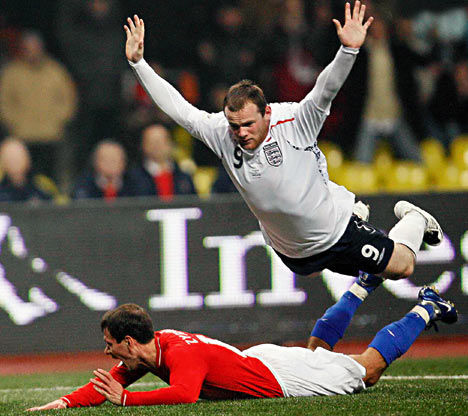
But maybe, some dives make it hard for anyone to argue the annoyance of that habit.



Follow us on Twitter (@Footballmood)